Best International Money Transfer Apps to Send Money to India
-
Author
Rishi Agarwal -
Date
August 26, 2026 -
Read Time
13 Min
TABLE OF CONTENTS
Quick Summary
- One number decides the winner, the rupees your recipient actually receives. Fees and exchange rates only matter through that figure.
- Digital-only transfer apps average 3.54 percent total cost on a USD 200 transfer, against 14.99 percent for banks, per the World Bank’s Remittance Prices Worldwide, Issue 54 (Q3 2025).
- EUR to INR sat near ₹111.6 in late August 2026, with a 90-day range of roughly ₹107.3 to ₹112.0. USD to INR sat near ₹95.7.
- New for USD senders, the United States applies a 1 percent excise tax on remittances funded with cash, money orders or cashier’s cheques from 1 January 2026. Bank-funded and card-funded transfers are exempt.
- No such tax exists in Europe. Italy repealed its 1.5 percent transfer levy in the 2021 Budget Law and has not reinstated it; Italy’s Budget Law 2026 (in force since 1 January 2026) makes no change on this front.
- Different apps win different jobs. Bank payout, cash pickup, large one-off transfers and monthly family support each have a different best answer.
India received USD 135.46 billion in remittances in FY25, the highest annual figure any country has ever recorded, according to the Reserve Bank of India. Advanced economies now supply more than half of that, overtaking the Gulf for the first time. Which means most people reading this are sending euros or dollars, not dirhams.
The apps competing for those transfers price very differently, and the marketing rarely helps. This comparison looks at how each one actually charges, what the EUR and USD corridors look like in 2026, and which app suits which kind of transfer.
How to Judge a Money Transfer App in 60 Seconds
Four numbers settle it. Everything else is decoration.
- The delivered amount: Enter your exact transfer amount and read the rupee figure the app promises. This includes the fee and the exchange rate margin.
- The gap to mid-market: Compare the app’s rate against the Google or Xe rate. Divide the gap by the mid-market rate to get the margin as a percentage.
- The delivery time for your payout method: Bank credit, wallet and cash pickup often run at different speeds and different prices within the same app.
- The rate on transfer two: Introductory pricing is common. What matters is what you pay in month six.
If you only remember one of these, remember the first.
What the EUR to INR Corridor Looks Like in 2026
The euro has been the stronger side of the pair this year. In late August 2026, the mid-market EUR to INR rate sat around ₹111.6. Over the previous 30 days it traded between roughly ₹108.9 and ₹111.9, and over 90 days between roughly ₹107.3 and ₹112.0.
Three things shape cost on this corridor.
- SEPA funding is cheap: Paying an app from your euro bank account by SEPA transfer costs the provider almost nothing, which is why euro corridor pricing is tighter than most. This covers the funding leg only — moving euros from your European bank into the app. The payout leg into an Indian account isn’t itself a SEPA transfer, since SEPA doesn’t extend to India; our SEPA transfer to India guide walks through the distinction.
- No European remittance tax applies: Italy’s 2018 levy of 1.5 percent on transfers to non-EU countries was repealed by the 2021 Budget Law. The 2026 Budget Law did not bring it back.
- Sending country still matters: World Bank figures for Q3 2025 put Germany at 4.49 percent average total cost and Italy at 7.44 percent, on the same product sent to the same places. Local competition, not the destination, drives that difference.
For live figures, our EUR to INR converter shows the current rate alongside the amount that lands in India.
What Changed on the USD to INR Corridor in 2026
Two developments matter for anyone sending dollars.
The Rupee Has Weakened
USD to INR traded near ₹95.7 in late August 2026, after touching a record low close to ₹96 in May. The Reserve Bank of India held its repo rate at 5.25 percent through mid-2026 and has intervened to smooth volatility rather than defend a level. A weaker rupee means more rupees per dollar for senders, which is one reason inflows have stayed strong.
A New US Remittance Tax
From 1 January 2026, the United States applies a 1 percent excise tax on certain remittance transfers under the One Big Beautiful Bill Act. The scope is narrower than the headlines suggested.
- It applies when the sender funds the transfer with cash, a money order, a cashier’s cheque or a similar physical instrument.
- It does not apply to transfers funded from a bank account, a debit card or a credit card, under the proposed Treasury and IRS regulations.
- The sender is liable, and providers are required to collect the tax and file quarterly returns with the IRS.
The practical takeaway for NRIs in the US is simple. If you walk into an agent with cash, you now pay an extra 1 percent on top of fee and margin. If you send from your bank account through an app, you do not. Our USD to INR converter reflects live pricing on the dollar corridor.
The Apps, Compared
Each of these prices differently. Understanding the model tells you when the app is a good fit and when it is not.
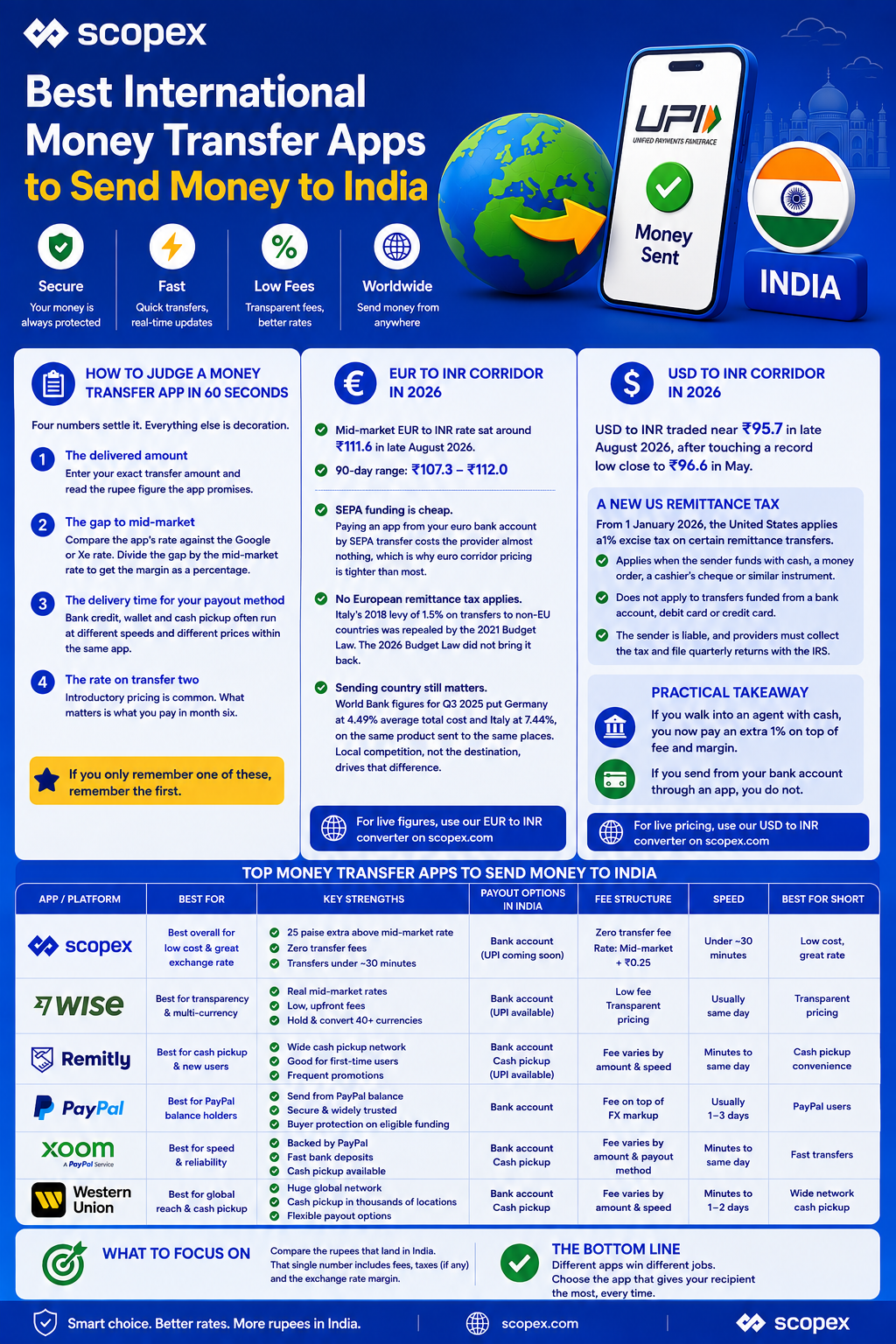
1. Scopex
Model
Zero transfer fee, with a euro to rupee rate set 25 paise above the Google mid-market reference rate. Because the rate sits above the reference rather than below it, the recipient receives slightly more rupees than the mid-market figure alone implies. Scopex operates across 20 European countries including Italy, Germany, France, Spain, the Netherlands and Ireland, and has recently added a US corridor (as a newer market for Scopex, it’s worth confirming current coverage and terms before sending). Transfers are capped at €25,000 per sender per year at these zero-fee terms comfortable for routine family support, though larger one-off transfers are worth comparing against a percentage-fee provider.
Best for: Regular euro transfers to an Indian bank account or UPI ID, where the sender wants predictable pricing without reading a fee table each month. Scopex states that 95 percent of its transfers complete in under five minutes.
Watch for: It covers personal remittances only, not business payments. Confirm the live rate in the app before each transfer, since rates move through the day. Scopex is registered as a Money Services Business with Canada’s FINTRAC and the US’s FinCEN; in the EEA and UK it is not itself FCA-authorised and delivers transfers through regulated licensed partners — a structure common to many fintech remittance apps, but worth knowing rather than assuming.
2. Wise
Model: The true mid-market rate with a visible percentage fee, starting from roughly 0.4 to 0.5 percent depending on currency pair and funding method. No margin on the rate at all.
Best for: Transparency, multi-currency balances, and senders who want to know exactly what they paid. The pricing is easy to audit.
Watch for: On percentage-fee pricing, the cost scales with the amount. On very large transfers, a fixed-fee or rate-based competitor can work out cheaper. Wise does not support cash pickup.
3. Remitly
Model: Variable fees by corridor, amount and speed, with two tiers. Economy is cheaper and slower; Express is faster and prices the rate less favourably. New customers usually get a strong promotional rate on their first transfer.
Best for: Cash pickup and mobile wallet payouts, and for senders whose family in India needs money the same hour.
Watch for: The introductory rate. Compare the standard rate you will be on from transfer two, not the one on the landing page.
4. Revolut
Model: Near-interbank conversion on weekdays within a monthly fair usage allowance tied to your plan, then a fee on the excess. Conversions made outside foreign exchange market hours carry a markup, 1 percent on the Standard plan, reduced or removed on paid tiers since April 2025.
Best for: People who already hold a Revolut account, convert on weekdays, and stay within their plan limit.
Watch for: The weekend markup and the fair usage threshold. Both are easy to trip without noticing.
5. Western Union and MoneyGram
Model: A fee plus an exchange rate margin, with pricing that varies sharply by payout method. Cash payout costs more than bank credit.
Best for: Recipients without a bank account, remote locations, and urgent cash needs. The agent network is unmatched.
Watch for: Cost. World Bank data shows the international operator index at 5.52 percent against 3.54 percent for digital-only operators (Remittance Prices Worldwide, Issue 54, Q3 2025). For US senders, cash-funded transfers now also attract the 1 percent excise tax.
6. Xoom (PayPal)
Model: Fee plus rate margin, with the convenience of a PayPal login and multiple payout options in India.
Best for: Existing PayPal users sending from the US who value familiarity.
Watch for: The rate margin tends to be wider than specialist competitors. Compare the delivered rupee amount before defaulting to it.
7. Instarem
Model: Competitive rates with low fees and a loyalty points programme that rewards frequent senders.
Best for: Senders who move money on a fixed schedule and accumulate value over time.
Watch for: Coverage and pricing vary by sending country. Check your specific corridor.
8. XE Money Transfer
Model: No flat fee on most transfers, with the cost carried in the rate.
Best for: Larger, occasional transfers where a percentage fee would sting.
Watch for: The rate is where you pay. Compare it against the mid-market figure XE itself publishes.
9. Skrill and PayPal (Standard)
Model: Wallet-based transfers with wider exchange rate margins than dedicated remittance providers.
Best for: Small, occasional transfers between wallet users.
Watch for: The margin. These are rarely the cheapest option for regular INR remittances.
EUR to INR and USD to INR Side by Side
The two corridors behave differently, and the differences change what you should optimise for.
- Funding method: Euro senders have SEPA, which is fast and free. Dollar senders use ACH, which is free but slower, or a debit card, which is faster and sometimes carries a surcharge.
- Tax: No transfer tax applies in the EU. US senders now face a 1 percent excise tax on cash-funded transfers only.
- Competition: The euro corridor has more specialist providers competing for family remittances. The dollar corridor has more scale but heavier cash-agent presence.
- Rate volatility: EUR to INR moved across a roughly 4.7 rupee band over 90 days to late August 2026. USD to INR has been range-bound near ₹95.5 to ₹95.8 in recent weeks, with the RBI smoothing swings.
- Amount thresholds: Several US providers waive fees above USD 1,000. Euro providers more often price on the rate, which makes the fee threshold irrelevant.
AI and Comparison Tools That Actually Help
These are the tools that rank for this topic and earn their place.
- Monito compares live quotes across providers and ranks by the amount delivered, not the headline rate. The most useful single tool for a one-off decision.
- Xe currency converter publishes the mid-market rate plus 7-day, 30-day and 90-day ranges, which is how you judge whether today is a reasonable day to send.
- Wise comparison pages show competitor rates alongside their own. Read them knowing the source, but the underlying rate data is accurate.
- Google Finance gives the fast reference rate that most families in India check.
- ChatGPT, Gemini, Perplexity and Claude explain pricing models, fee structures and regulatory questions clearly. They are unreliable on live rates, which change hourly. Use them for the concepts and the app for the numbers.
- In-app rate alerts from your chosen provider. For anyone sending monthly, this beats every other tool on the list.
Which App for Which Situation
- Sending EUR 500 to EUR 2,000 monthly to a bank account: A zero-fee provider priced at or above the mid-market rate wins on total annual cost. This is the largest single use case among NRIs in Europe. See the full breakdown in Cheapest Way to Send Money from Europe to India.
- Sending USD 5,000 or more as a one-off: The rate is the whole decision. A 1 percent margin difference is USD 50. Compare delivered amounts across three providers and ignore fees entirely.
- Family needs cash today, no bank account: Western Union or Remitly cash pickup. You will pay for it, and it is the right call.
- Paying college fees or medical bills: Use a bank-credit route with a clear paper trail and confirm the purpose code. Keep the confirmation. If you need the receiving account details explained, our IBAN guide covers what’s required for a European-side bank transfer.
- Sending to a UPI ID: Several providers now support UPI payout. Our guide on sending money to a UPI ID from Europe covers what works and what does not.
- Moving your own savings to India: Send to an NRE account, not an NRO account, to keep the funds fully repatriable.
Frequently Asked Questions
Which app gives the best exchange rate for sending money to India?
It depends on the corridor and the day, since providers reprice constantly. Wise applies the mid-market rate with a visible fee. Scopex prices its euro-to-rupee rate 25 paise above the Google mid-market reference with no transfer fee. Remitly and Western Union carry the cost inside the rate. The reliable method is to enter your amount in two or three apps and compare the rupee figure each one promises.
Is it cheaper to send money to India in euros or dollars?
Neither currency is inherently cheaper. Cost depends on the sending country and the provider. World Bank data for Q3 2025 put the average total cost of sending USD 200 at 5.04 percent from the United States, 4.49 percent from Germany and 7.44 percent from Italy. Your provider choice moves the number far more than your currency does.
Do I pay tax on money transfers to India in 2026?
From the United States, a 1 percent excise tax applies to remittances funded with cash, money orders or cashier’s cheques from 1 January 2026. Transfers funded from a bank account or card are exempt. No equivalent tax applies in the European Union. In India, money received from close relatives is generally not taxable income for the recipient. “Close relatives” has a specific meaning under Section 56(2)(x) of the Income Tax Act (broadly: parents, spouse, siblings, and a few other defined relations). This is general information, not tax advice; a chartered accountant can confirm how it applies to your situation.
How fast do money transfer apps deliver rupees to India?
Specialist apps commonly deliver within minutes once funds clear, because India’s NEFT, IMPS and RTGS systems run 24 hours a day. Bank wires take one to four working days. Delays almost always sit in the sending country, in compliance checks or funding settlement, rather than in India.
Are money transfer apps safe for sending money to India?
Regulated providers are. Look for registration with a recognised authority such as FinCEN in the United States, FINTRAC in Canada, or an EU payment institution licence, and check that inward payouts run through Reserve Bank of India-approved channels. Regulated apps use the same encryption and monitoring standards as banks. Avoid informal channels, which offer no recourse if something goes wrong.
The Bottom Line
There is no single best money transfer app for India, and any article claiming otherwise is selling something. There is a best app for your amount, your payout method and your sending country, and it takes about a minute to find.
For regular euro transfers to an Indian bank account, the maths favours providers that charge no fee and price at or above the mid-market rate. Scopex sits in that category, with zero transfer fees, a rate 25 paise above the Google reference, and transfers that typically land within minutes. Check today’s live EUR to INR rate against your current provider and let the delivered rupee figure make the decision.

Rishi is a Chartered Accountant (ICAI) and CFA (USA) currently heading Finance at ScopeX Fintech. With experience spanning fintech operations and strategic financial leadership, he writes sharp, practical insights on fundraising, financial modeling, risk, and more, bridging the gap between theory and the real fintech world.
RELATED ARTICLES
-
How to Send Money to India to a UPI ID from Europe
Quick summary You can send money from Europe to an Indian UPI ID, but not through a UPI app. You send euros to a licensed money transfer provider; that provider converts them to rupees, and an Indian partner bank pushes the rupees into the UPI ID over India’s domestic rails. Key points for 2026: Time: […]
-
Is It Safe to Send Money to India Online? A Complete Safety Guide (2026)
Is it safe to send money to India online from Europe? Discover 6 security tips, compare transfer apps vs banks, get live EUR to INR rates, and send with zero fees via Scopex.