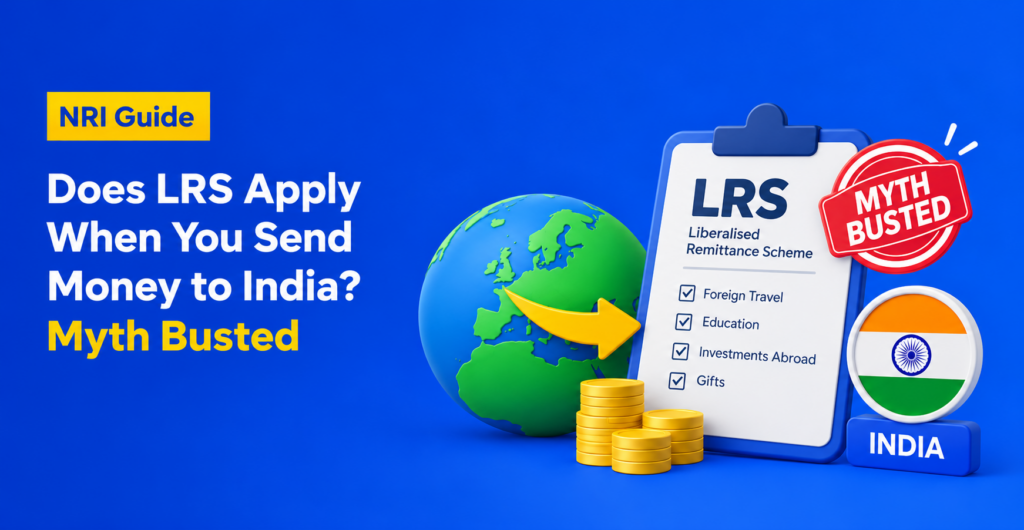
Does the Liberalised Remittance Scheme (LRS) Apply When You Send Money To India? (The Myth, Busted)
-
Author
Rishi Agarwal -
Date
September 8, 2026 -
Read Time
13 Min
TABLE OF CONTENTS
The Liberalised Remittance Scheme covers outward remittances only, money that resident Indians send abroad. It does not apply when you, an NRI in Europe, send money to India. Inward remittances fall under a separate FEMA framework, and the RBI places no upper limit on legitimate personal transfers into India. The $250,000 annual LRS cap and the Tax Collected at Source rules that come with it apply exclusively to residents of India sending money out. Whether you send euros or dollars, if the transfer runs into an Indian bank account, LRS never enters the picture.
If you have searched “does LRS apply to money sent to India,” you have probably run into forum threads, half-read bank FAQs, and finance explainer videos that blur the two directions together. It is an easy mistake to make. LRS is one of the most discussed compliance terms in NRI finance circles, so people assume it touches every cross-border transaction involving India. It does not. This guide walks through what LRS actually covers, what rules govern the money you send home from Europe, whether you use EUR to INR or USD to INR, and where the real tax questions sit.
What Is the Liberalised Remittance Scheme?
The Reserve Bank of India introduced LRS in February 2004 under the Foreign Exchange Management Act, 1999. It gives resident individuals in India permission to remit foreign exchange abroad, up to $250,000 per financial year, without seeking RBI approval for each transaction. Before LRS existed, every outward transfer needed individual clearance, which made even routine payments slow. The limit has stayed at $250,000 per financial year through FY 2026-27, with no change announced.
A few things define who and what LRS covers.
- It applies only to persons classed as residents in India under FEMA. Non-resident Indians, OCIs, companies, HUFs, partnership firms, and trusts cannot use it.
- Minors can remit under LRS, but a parent or legal guardian must sign the declaration.
- Permitted purposes include funding education abroad, medical treatment overseas, international travel, investing in foreign stocks or property, maintaining close relatives abroad, and gifting to relatives outside India.
- Transfers are made through Authorised Dealer banks using a Form A2 declaration, and the $250,000 cap is tracked cumulatively across every bank the individual uses, not per bank.
The scheme exists to make it easier for residents of India to move money out for legitimate purposes. It was never designed to govern money coming in.
LRS Does Not Apply to Money Sent to India
LRS governs outward remittance from India. It has no jurisdiction over inward remittance, meaning money sent from abroad into an Indian bank account. When you send money to India from your account in Europe, whether in euros or dollars, you are not a resident individual filing an A2 form, and there is no LRS ceiling for you to track.
A few points worth holding onto:
- LRS applies to the sender’s residency status in India, not to the recipient’s location.
- NRIs, OCIs, and foreign nationals sending money into India operate entirely outside the LRS framework.
- There is no RBI-imposed annual limit on how much you can send home for personal purposes through a regulated channel.
- Tax Collected at Source under LRS is charged on outward transfers only. It is never applied to money arriving in India.
Where the Myth Comes From
The confusion is understandable once you see how the vocabulary overlaps. Both directions involve the words remittance, FEMA, and RBI, so headlines and casual explainers often use them interchangeably. News stories about the $250,000 LRS cap circulate widely, and people extend that number to any cross-border transfer touching India, regardless of direction.
There is also a second scheme that gets tangled into the same conversation: the NRO repatriation limit. NRIs moving India-sourced income out of the country through an NRO account face a separate cap of $1 million per financial year. That is also an outward scheme, just a different one from LRS, and mixing the two adds another layer of confusion.
Finally, both inward and outward transfers use RBI purpose codes on the bank’s backend. Seeing a purpose code attached to your inward transfer makes it feel like the same regulatory regime as LRS, when it is simply a classification tag, not a cap.
What Actually Governs Money You Send to India from Europe
Inward remittances do not sit under a single named scheme the way outward transfers do. Instead, they are handled under FEMA’s general framework for foreign exchange transactions, administered through Authorised Dealer Category I banks or licensed money transfer operators, for both EUR to INR and USD to INR transfers.
Here is what actually happens on the Indian side of your transfer:
- The receiving bank assigns a purpose code from the RBI’s standard list, describing why the money was sent, for example, family maintenance, gift, or investment.
- For personal remittances, there is no RBI ceiling on the amount. A single transfer of €2,000 or $50,000 is not, by itself, against any rule, provided the funds come from a legitimate source and move through an authorised channel.
- Large or unusual transactions may trigger routine reporting to India’s Financial Intelligence Unit for anti-money-laundering purposes. This is monitoring, not a restriction on the amount.
- A Foreign Inward Remittance Certificate, or its electronic form, may be issued as proof of receipt. This matters mainly for business and export-related transfers rather than personal family remittances, though your recipient can request one if needed for documentation.
None of this resembles a cap, and none of it is LRS.
Is the Money You Send to India Taxable?
For the person receiving it, usually not, provided the sender is a relative as defined under Indian tax law.
The Income-tax Act, 2025 replaced the 1961 Act with effect from 1 April 2026, and it renumbered several familiar provisions. The gift taxation rule that most people know as Section 56(2)(x) now sits under Section 92 of the new Act. The underlying rule has not changed in substance, only the section number, so both references are used here for clarity.
Gifts received from a relative are exempt in full, regardless of the amount. The definition of relative is broader than people expect and includes:
- Spouse
- Brother or sister
- Brother or sister of the spouse
- Brother or sister of either parent
- Any lineal ascendant or descendant
- Any lineal ascendant or descendant of the spouse
- Spouse of any of the individuals listed above
So a transfer from a son, daughter, spouse, parent, sibling, or even an uncle or aunt falls within the exemption and is not taxable for the recipient, no matter the size of the transfer.
If the sender is not a relative under this definition, gifts are exempt only up to ₹50,000 in aggregate per financial year. Cross that threshold and the entire amount, not just the excess, becomes taxable in the recipient’s hands as income from other sources.
One distinction matters here. The remittance itself is a transfer of funds you already own, not income, so it is not taxed as such. What is taxable is any interest or investment return the recipient later earns from that money, for example, interest on a savings account or fixed deposit, taxed according to their applicable income slab.
Good practice, even where nothing is technically required, is to keep a simple record: proof of the relationship, the bank statement showing sender and recipient, and for larger one-off transfers to a non-relative, a short gift letter. It is inexpensive insurance if the transaction is ever questioned later.
TCS on LRS: Why It Never Touches Your Transfer to India
Tax Collected at Source is the part most people get tangled up in, because it does sound like a tax on remittances generally. It is not. TCS on foreign remittance applies exclusively to LRS transactions, meaning it is collected from resident Indians remitting money out of the country. Under the 1961 Act, this sat in Section 206C(1G); under the Income-tax Act, 2025, effective from 1 April 2026, the same rule has been recodified, commonly referenced as Section 394(1).
The TCS-free threshold has been ₹10 lakh per financial year since 1 April 2025, tracked per PAN across all Authorised Dealer banks combined, and that threshold is unchanged for FY 2026-27. What did change is the rate structure, updated by the Finance Act 2026 effective 1 April 2026:
- 2% for self-funded overseas education and medical treatment remittances above the threshold, down from the earlier 5%
- 2% flat on overseas tour packages
- Nil for education funded through a loan from a specified financial institution
- 20% for most other purposes, including investments and gifting by residents
Every part of this mechanism sits on the outward side. TCS is collected by the sending bank when a resident Indian crosses the threshold under LRS. Since your transfer from Europe to India is not an LRS transaction in the first place, TCS has nothing to do with it. Your recipient does not see any deduction of this kind, and you as the sender in Europe are not filing an A2 form or triggering any Indian withholding.
LRS Versus Inward Remittance to India: A Quick Comparison
LRS – Outward Remittance from India
- Who can use it: Resident individuals in India only
- Direction of money: Leaving India
- Annual cap: $250,000 per financial year
- TCS: Yes, above the ₹10 lakh threshold
- Documentation: Form A2 declaration with the Authorised Dealer bank
- Typical purposes: Education, travel, medical treatment, investment, gifting abroad
Inward Remittance to India
- Who sends it: NRIs, OCIs, foreign nationals, anyone remitting from abroad
- Direction of money: Entering India
- Annual cap: One set by the RBI for personal remittances
- TCS: No
- Documentation: Purpose code assigned by the receiving bank
- Typical purposes: Family support, gifts, investment, loan repayment
When Could LRS Indirectly Matter to You?
There are a few scenarios where LRS becomes relevant to someone in your position, though never for the transfer you are sending today.
- If you move back to India and become a resident under FEMA, any future money you send abroad from India would then fall under your personal LRS limit.
- If funds sitting in an NRO account, representing India-sourced income, need to move back out of India, that is governed by the separate NRO repatriation limit of $1 million per financial year, not LRS.
- If your parents in India later want to send money back out to you, perhaps to invest in your name abroad, that outward leg would count against their own LRS limit as residents, since they would be the ones initiating an outward transfer.
How to Send Money to India the Compliant Way
None of this requires elaborate paperwork on your end as a sender in Europe. A few habits keep things straightforward.
- Use a regulated channel: A bank wire or a money transfer platform licensed by a recognised financial authority in your country.
- Send to the right account: An NRE or NRO account for an NRI recipient, or a standard resident savings account for family members living in India.
- Keep a light paper trail: The relationship to the recipient, the purpose of the transfer, and a screenshot or confirmation of the transaction.
- If the recipient is not a specified relative and the gift exceeds ₹50,000 in a year, plan for it to be taxable on their end, and let them know in advance.
- For a large one-off transfer to a relative, a simple one-page gift declaration is sensible practice, cheap to prepare and useful if the transaction is ever reviewed later.
Choosing a Zero-Fee Money Transfer App for EUR to INR or USD to INR Transfers
Since there is no legal ceiling to worry about on a personal inward transfer, the decision that actually matters is which provider gets your family the most rupees for the least cost. That comes down to three things: the fee charged upfront, how close the exchange rate sits to the real mid-market rate, and how fast the money actually lands.
A genuinely zero-fee money transfer app should show a rate close to the mid-market benchmark you see on Google, rather than making up for a 0% fee with a wider margin on the exchange rate. That distinction is worth checking on every transfer, not just the first one, since rates and promotions change.
A few checks before you send:
- Look up the real mid-market EUR to INR or USD to INR rate on Google or a currency reference site before comparing providers, so you know what a fair conversion looks like. Through 2026, USD to INR has broadly traded in the low nineties, and EUR to INR has moved in a wider band, so checking the live rate matters more than memorising a number.
- Run the same amount through a live rate comparison tool that ranks providers by the amount actually delivered, not the headline rate advertised on their homepage, an approach covered in more depth in our roundup of the best international money transfer apps to send money to India.
- Check a provider’s live rate directly before confirming a transfer, for both EUR to INR and USD to INR corridors if you send in more than one currency.
- If your recipient will invest the money and start earning returns on it, a basic income tax calculator can help them estimate any tax due on that future interest or investment income, since that portion, unlike the remittance itself, is taxable.
For reference, Scopex is one such zero-fee money transfer app built for NRIs sending money from Europe to India, in both EUR to INR and USD to INR corridors. It charges no transfer fee, applies a rate that runs about 25 paise better than Google’s reference rate, and transfers typically complete in under 30 minutes. Whichever app you choose, running these checks yourself takes a few minutes and is the only real due diligence a personal remittance needs.
Frequently Asked Questions
Does LRS apply to NRIs sending money to India?
No. LRS applies only to individuals who are residents of India under FEMA, and only to money they send abroad. An NRI sending money into India from Europe or anywhere else is entirely outside the LRS framework.
Is there a limit on how much money I can send to India from Europe?
The RBI does not set an upper limit on legitimate personal remittances into India through authorised channels. Individual banks or transfer providers may apply their own transaction limits for anti-money-laundering checks, so it is worth confirming those with your chosen provider, but this is a provider policy, not an RBI or LRS restriction.
Will my parents have to pay tax on the money I send them from Europe?
Generally no. If you are a specified relative under Indian tax law, which includes children, spouses, siblings, parents, and several other close relations, the amount is fully exempt from tax for the recipient regardless of size. Tax only becomes relevant on any income they later earn from that money, such as interest.
What is the difference between LRS and TCS on foreign remittance?
LRS is the scheme that permits and caps outward remittance from India at $250,000 per financial year for residents. TCS is a tax collected by the bank when a resident’s LRS remittances cross ₹10 lakh in a year. Both concepts apply only to money leaving India, never to money entering it.
Do I need Form 15CA or 15CB to send money to India?
No. Forms 15CA and 15CB apply to certain remittances made out of India, largely relevant to residents or entities sending money abroad. As someone sending money into India from Europe, neither form applies to your transaction.
The Bottom Line
LRS was built to give resident Indians a straightforward, capped way to send money abroad. It was never meant to touch the reverse journey. When you send money from Europe to India, whether in euros or dollars, the questions that matter are about the relationship between sender and recipient for tax purposes and about which app or bank gets the best rate to your family, not about any LRS paperwork or ceiling.
Understanding that distinction up front saves you from chasing a compliance requirement that was never yours to begin with. Once that question is settled, the only real decision left is picking a provider with a transparent, close-to-mid-market rate and fast delivery, which is a rate and speed comparison, not a compliance exercise.

Rishi is a Chartered Accountant (ICAI) and CFA (USA) currently heading Finance at ScopeX Fintech. With experience spanning fintech operations and strategic financial leadership, he writes sharp, practical insights on fundraising, financial modeling, risk, and more, bridging the gap between theory and the real fintech world.
RELATED ARTICLES
-

NRI Financial Checklist for FY 2026–27: 12 Things to Do Before July 31
Key thresholds at a glance NRIs with Indian income above ₹4 lakh (new tax regime) or ₹2.5 lakh (old tax regime) must file ITR-2 by 31 July 2026. Additional mandatory filing triggers apply even below these limits — see Item 5. The NRO repatriation limit of USD 1 million reset on 1 April 2026. The […]
-

Capital Gains Tax for NRIs: How It Works, Rates, and Key Rules in India
Quick Answer Property (LTCG):5% flat, no indexation for NRIs regardless of when you bought it Property (STCG): Taxed at your income tax slab rate Listed equity/equity mutual funds (LTCG): 5% on gains above ₹1.25 lakh/year Listed equity/equity mutual funds (STCG): 20% TDS on property sale: Deducted on the full sale value, often 12.5–30%+ with surcharge and cess […]
-
DTAA Explained for NRIs: How Double Taxation Avoidance Agreements Work
Why DTAA Is Important for NRIs Non-Resident Indians often earn income across more than one country. Salary, interest, dividends, capital gains, or rental income may be subject to tax in the country where it is earned as well as in India. Without safeguards, this can lead to the same income being taxed twice, significantly reducing […]