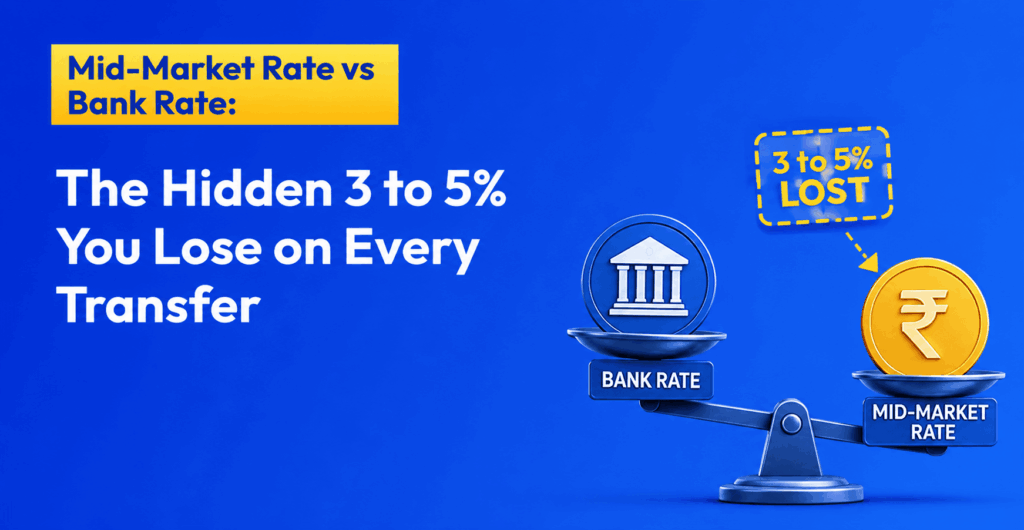
Mid-Market Rate vs Bank Rate: The Hidden 3 to 5 Percent You Lose on Every Transfer
-
Author
Rishi Agarwal -
Date
September 2, 2026 -
Read Time
11 Min
TABLE OF CONTENTS
Quick Summary
- The mid-market rate is the real exchange rate. It is the midpoint between the buy and sell prices banks quote each other, and it is what Google, Reuters and Xe display.
- A bank rate is the mid-market rate minus a margin. That margin is the bank’s profit on the conversion, and it is not shown as a fee. Our full banks vs money transfer apps comparison breaks the two pricing models apart.
- Typical retail margins run 3 to 5 percent. On EUR 2,000 that is EUR 60 to EUR 100, invisible on the receipt.
- The data backs this up. World Bank figures for Q3 2025 put the average total cost of a bank transfer at 14.99 percent of a USD 200 transfer, against 3.54 percent for digital-only providers.
- “Zero fees” does not mean zero cost. Many zero-fee providers simply move the charge into the rate.
- One formula tells you what you paid: (Mid-market rate minus your rate) divided by mid-market rate, times 100.
You check the EUR to INR rate on your phone. It says ₹111.60. You start the transfer at your bank and the confirmation screen says ₹107.90. Nobody charged you a fee. Nothing on the receipt explains the difference.
That gap is the exchange rate margin, and it is the highest cost in international money transfer that most people never see. On a EUR 2,000 transfer, a 3.3 percent margin costs ₹7,400. Send that amount monthly and you lose close to ₹89,000 a year to a line item that does not exist on any statement.
This guide explains what the mid-market rate is, why your bank never gives it to you, how to work out exactly what you are paying, and what to do about it.
What is the mid-market exchange rate?
The mid-market rate is the midpoint between the highest price a buyer will pay for a currency and the lowest price a seller will accept for it, at a given moment on the global foreign exchange market. It is also called the interbank rate, the spot rate or the real rate.
A few points worth understanding.
- Nobody transacts at it: It is a reference point, not a price you can buy at. Even banks trade at a spread around it.
- It moves constantly: Foreign exchange markets run around the clock on weekdays. The rate you saw an hour ago is already stale.
- It is publicly visible: Google, Xe, Reuters and Bloomberg all publish it. This is what makes it the fair benchmark for judging any quote you receive.
- It closes at the weekend: From roughly Friday evening to Sunday evening, markets are shut. Providers that convert during this window carry price risk, and most pass it on.
When people say a provider “gives you the real rate”, this is the rate they mean. Our roundup of the best international money transfer apps to send money to India scores every provider against exactly this benchmark.
What is a bank rate and where does the margin come from?
A bank rate is the mid-market rate with a margin subtracted. The bank buys currency at or close to interbank prices and sells it to you at a worse price. The difference is revenue.
Banks defend this on three grounds, and each has some merit.
- Price risk. Between the moment you confirm and the moment the bank settles its own position, the rate can move.
- Operational cost. Compliance checks, sanctions screening, SWIFT messaging and settlement all cost money.
- Providing rupees on demand requires holding positions in a currency the bank may not otherwise want.
The problem is not that a margin exists. The problem is that it is not disclosed as a price. A 3.5 percent margin presented as an exchange rate feels like a market condition. Presented as a fee, it would feel like an expensive one.
How big is the gap? The evidence
The World Bank measures the total cost of remittances across hundreds of country pairs, splitting each transfer into fee and foreign exchange margin. The most recent published release covers Q3 2025.
- Banks averaged 14.99 percent of a USD 200 transfer, the most expensive provider type by a wide margin.
- Money transfer operators averaged 4.72 percent.
- Digital-only operators averaged 3.54 percent, measured across Wise, Remitly, WorldRemit, Instarem and Xoom.
- The global average across all provider types was 6.36 percent.
- Funding from a bank account averaged 8.69 percent worldwide, against 4.39 percent for debit or credit card funding.
- Sending to a bank account within the same bank or a partner bank averaged 13.91 percent, against 7.86 percent for a bank account at any institution.
The last figure is the one that surprises people. The route that sounds most efficient, bank to partner bank, prices worst of all. Convenience and cost point in opposite directions here.
Percentages fall as amounts rise, because flat costs spread further. Sending USD 500 rather than USD 200 brought the global average down to 4.08 percent. The margin does not disappear. It just represents a smaller slice.
How to calculate the margin you are paying
One formula, ten seconds.
Margin percentage = ((mid-market rate minus your rate) ÷ mid-market rate) × 100
Worked example: euros to rupees
Say the mid-market EUR to INR rate is ₹111.60 and your bank offers ₹107.90 on a EUR 2,000 transfer.
- Gap: 111.60 minus 107.90 = ₹3.70 per euro
- Margin: (3.70 ÷ 111.60) × 100 = 32 percent
- Cost on this transfer: 3.70 × 2,000 = ₹7,400, roughly EUR 66
- At mid-market, you would have delivered ₹223,200. You delivered ₹215,800 instead.
Worked example: dollars to rupees
Mid-market USD to INR at ₹95.70, provider quoting ₹92.80 on USD 3,000.
- Gap: ₹2.90 per dollar
- Margin: (2.90 ÷ 95.70) × 100 = 03 percent
- Cost: 2.90 × 3,000 = ₹8,700, roughly USD 91
- No fee appeared anywhere on the confirmation.
Run this once on your current provider. Most people are surprised, and the surprise is what changes behaviour.
What 3 to 5 percent costs over time
A single transfer at a 3 percent margin feels tolerable. The compounding is where it hurts.
Take an NRI in Europe sending EUR 1,500 home every month, which is a common pattern among engineers, nurses and hospitality workers across Milan, Frankfurt and Dublin.
- At a 3.5 percent margin: Roughly EUR 52.50 lost per transfer, or EUR 630 a year.
- At a 1 percent margin: Roughly EUR 15 per transfer, or EUR 180 a year.
- At or above mid-market with no fee: Close to nothing, and in some cases the recipient receives slightly more than the reference rate implies.
- Difference over five years, comparing the first and second scenarios: EUR 2,250.
That is a return flight to India for a family of four, funded entirely by changing which app you open. No extra money leaves your account.
Why “zero fees” is not the same as “zero cost”
Zero-fee marketing works because it answers the question people ask. The question people should ask is different.
There are three honest versions of zero-fee pricing and one misleading one.
- Genuinely low cost: No fee, and a rate at or very close to mid-market. The provider makes money on volume, on other products, or on a small spread.
- Fee moved into the rate: No fee, and a rate 2 to 4 percent below mid-market. This costs more than a visible fee would.
- Fee waived above a threshold: Several US providers waive fees above USD 1,000 while keeping a rate margin. Read both numbers.
- Promotional first transfer: A strong rate once, then standard pricing. Check what you pay on transfer two.
The reverse case is worth naming too. A provider charging a visible 0.45 percent fee at the exact mid-market rate is cheaper than a zero-fee provider running a 3 percent spread. Fees are honest when they are the whole story. We walk through how to sanity-check a provider end to end in is it safe to send money to India online.
Compare the delivered amount. It is the only figure that captures both.
Weekend, holiday and volatility markups
Foreign exchange markets close from roughly 17:00 Eastern Time on Friday until 18:00 on Sunday. Any provider converting during that window is pricing without a live market, and most add a markup to cover the risk.
Revolut, for example, applies a 1 percent markup on conversions outside market hours for Standard plan customers, with the charge reduced or removed on paid tiers since April 2025. Less-traded currency pairs can carry a higher weekend markup than major ones. Other providers handle it by simply widening the spread without labelling it.
The practical rule is short. Convert on a weekday. If your salary lands on a Friday, the extra two days rarely cost you more than the weekend markup does.
The same logic applies during volatility. The rupee touched a record low near ₹96.6 to the dollar in May 2026 before recovering, and providers widen spreads when a currency moves fast. A calm Tuesday prices better than a turbulent one.
How to check the mid-market rate in 30 seconds
Every one of these is free and takes seconds.
- Search “EUR to INR” or “USD to INR”. Google returns the mid-market rate. This is the reference most Indian families use.
- Publishes the mid-market rate with 7-day, 30-day and 90-day ranges, which tells you whether today is high or low within the recent band.
- Compares live quotes across providers and ranks by the amount actually delivered rather than the advertised rate.
- AI assistants. ChatGPT, Gemini, Perplexity and Claude explain rate structures, margin mechanics and terminology clearly. They are unreliable for live rates because pricing changes by the minute. Use them to understand the concept, then check the number in a live tool.
- Rate alerts. Set one in your transfer app for the level you want. For monthly senders, this single habit outperforms all the manual checking.
Our currency converter tool shows live rates alongside the rupee amount that would reach India.
Six ways to shrink the spread
- Compare the delivered amount, never the fee: Enter the same amount in two or three providers and read the final rupee figure.
- Calculate your margin once: Apply the formula above to your current provider. If it comes out above 1 percent on a bank transfer, you have room to improve.
- Avoid bank wires for routine transfers: Reserve SWIFT for large one-off payments where a documented paper trail matters more than the rate. Note that a SEPA transfer cannot reach India at all, so the euro leg always converts somewhere.
- Convert on weekdays: Weekend markups are avoidable and predictable.
- Send fewer, larger transfers where practical: Flat costs spread further. World Bank data shows the global average falling from 6.36 percent on USD 200 to 4.08 percent on USD 500.
- Recheck your provider every six months: Pricing changes. The app that was cheapest last year may not be now, and introductory rates expire quietly.
Frequently asked questions
What is the difference between the mid-market rate and the bank rate?
The mid-market rate is the midpoint between the buy and sell prices in the global currency market, and it is the rate shown by Google, Xe and Reuters. A bank rate is that rate with a margin subtracted, typically 3 to 5 percent for retail customers. The margin is the bank’s revenue on the conversion and is not disclosed as a separate fee.
Can I get the actual mid-market rate on a money transfer?
Some providers apply the mid-market rate and charge a visible fee instead, which is functionally close. Wise works this way. A small number of providers price above the reference rate on specific corridors, so the recipient receives slightly more than the mid-market rate alone implies. Scopex does this on the euro to rupee corridor at 25 paise above the Google reference rate. No provider gives you the mid-market rate with no cost at all, since conversion has a real operating cost.
How do I know if my bank is overcharging on exchange rates?
Check the mid-market rate on Google, then check the rate your bank quotes for the same amount. Apply the formula: (mid-market rate minus your rate) divided by the mid-market rate, times 100. Anything above 2 percent on a straightforward bank transfer is expensive by 2026 standards, given that digital-only providers average 3.54 percent in total cost, including their fees.
Why do banks not show the exchange rate margin as a fee?
Disclosure rules in most markets require the exchange rate and any explicit fees to be shown, but do not require the margin to be broken out against a reference rate. So it stays inside the quoted rate. Comparison bodies, including the World Bank, measure fee and FX margin separately precisely because the second component is otherwise invisible to consumers.
Is a zero-fee transfer always cheaper?
No. A zero-fee transfer at a 3 percent exchange rate margin costs more than a 0.5 percent fee at the mid-market rate on any amount above a few hundred euros. The only reliable comparison is the amount your recipient receives, since that figure already includes both the fee and the margin.
Where this leaves you
The exchange rate margin is the most expensive line item in international money transfer and the only one that never appears on a receipt. Once you know how to measure it, the fix takes a minute. Check the mid-market rate, apply the formula, compare the delivered amount, and move on.
Scopex was built around this specific problem. No transfer fee, a euro-to-rupee rate set 25 paise above the Google mid-market reference, and transfers that typically land within minutes. Run the formula on your current provider, then check the live exchange rate and compare the two rupee figures. The arithmetic will tell you what to do next.

Rishi is a Chartered Accountant (ICAI) and CFA (USA) currently heading Finance at ScopeX Fintech. With experience spanning fintech operations and strategic financial leadership, he writes sharp, practical insights on fundraising, financial modeling, risk, and more, bridging the gap between theory and the real fintech world.