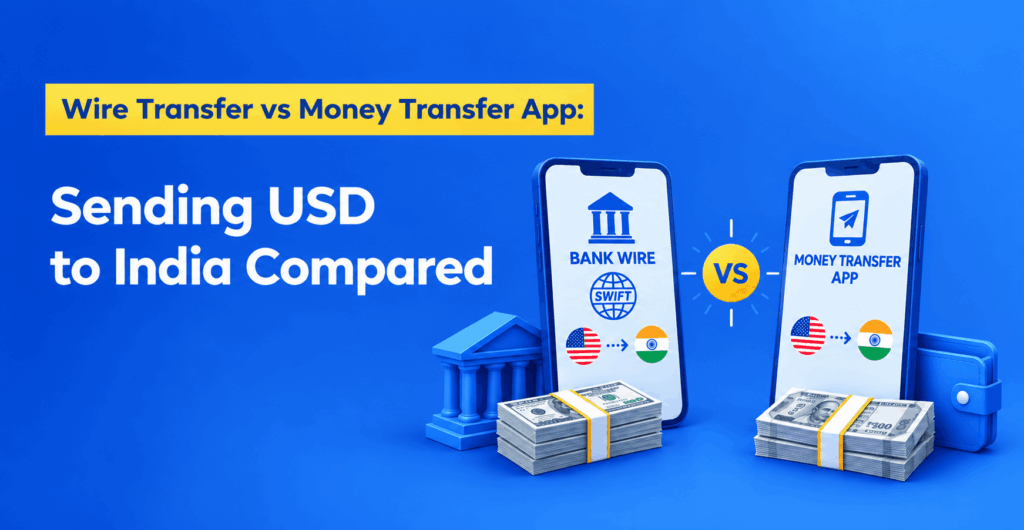
Wire Transfer vs Money Transfer App: Sending USD to India Compared
-
Author
Rishi Agarwal -
Date
September 11, 2026 -
Read Time
14 Min
TABLE OF CONTENTS
Quick Summary
If you are choosing between a bank wire and an app for a US-to-India transfer, here is the short version.
- A wire transfer pushes dollars through the SWIFT and correspondent banking network. A money transfer app collects dollars in the US and pays out rupees through an Indian partner bank on domestic rails.
- Cost gap: World Bank data for Q3 2025 puts the average total cost of a $200 transfer at 14.99% through banks and 3.54% through digital-only transfer operators.
- Fees: Major US banks charge roughly $25 to $50 for an outgoing international wire. Most India-focused apps charge $0 to $5.
- Exchange rate margin: Banks typically add 2% to 4% on top of the mid-market USD to INR rate. On most transfers, that markup costs more than the wire fee.
- Speed: Bank wires to India usually take one to three business days. App transfers to an Indian bank account often land the same day, and frequently within minutes.
- Tax: Since 1 January 2026, a 1% US federal excise tax applies only to remittances funded with cash, a money order or a cashier’s check. Bank account, debit card and credit card funding is exempt.
- Pick a wire for property purchases, large investments and any transfer where the Indian bank wants a named institutional sender. Pick an app for family support, rent, EMIs and monthly transfers.
- The only number that settles the comparison is the rupee amount that lands in your recipient’s account.
Most people sending dollars to India take one of two routes. They log in to a US bank and request an international wire, or they open an app and tap send. Both put rupees in an Indian account. The difference shows up in what your family actually receives and how long they wait.
This guide compares the two on cost, speed, limits, safety and paperwork, using published 2026 bank fee schedules and World Bank pricing data. It also covers the US remittance tax that took effect in January 2026 and the India-side rules that decide which account your money should land in.
How a bank wire transfer to India actually works
Your bank debits your account and sends a payment instruction across the SWIFT network to the recipient’s bank in India. If the two banks have no direct relationship, the instruction passes through one or more correspondent banks. Each hop can deduct a handling charge before the money moves on.
The messaging layer has modernised. The Fedwire Funds Service completed its move to the ISO 20022 standard on 14 July 2025, and SWIFT ended the old MT format for cross-border payment instructions on 22 November 2025. Payment data is richer and better structured than it was. The number of institutions standing between you and your family in India has not changed.
You also choose the sending currency. Send in US dollars and the Indian bank converts on arrival at its own rate. Send in rupees and your US bank converts before it leaves. That single choice often decides most of your cost.
How a money transfer app works
An app does not send your dollars overseas. It collects them inside the US, usually by an ACH pull from your checking account or a debit card charge. It then instructs a partner bank in India to release rupees to your recipient over India’s domestic rails: IMPS, NEFT or UPI. The two legs settle separately between institutions.
That structure explains the speed and the price. There is no correspondent chain, no SWIFT hop and no intermediary deduction in transit. The provider earns on the currency conversion, on a visible fee, or on both. The honest ones show you the rate before you confirm.
Scopex runs on this model for the US to India, with zero transfer fee and a published rate set 25 paise above the mid-market reference. Around 50,000 NRIs use it, and the company reports that 90% of transfers complete in under five minutes.
Wire transfer vs money transfer app
| Factor | Bank wire transfer | Money transfer app |
| Upfront fee | $25 to $50 for an outgoing international wire; more in branch | $0 to $5 on most India routes |
| Exchange rate margin | Roughly 2% to 4% over mid-market, not shown as a line item | 0% to 1.5% typically; several providers publish the exact rate |
| Average total cost (World Bank, Q3 2025, $200) | 14.99% across banks | 3.54% across digital-only operators |
| Correspondent deductions | $15 to $50 per hop is common | None; there is no correspondent chain |
| Speed to an Indian account | One to three business days | Minutes to same day |
| Payout options | Indian bank account only | Bank account, UPI ID, and cash pickup with some providers |
| Tracking | SWIFT reference, updates through the bank | Live status in the app |
| Per-transfer ceiling | High; set by your bank and account tier | Usually $10,000 to $25,000 per transaction |
| Best suited to | Property, investments, large one-off transfers | Family support, rent, EMIs, tuition top-ups |
The cost gap is wider than the fee suggests
What you can see: The wire fee
US bank fee schedules for 2026 sit in a narrow band. Chase charges $40 for an outgoing international wire sent online in US dollars and $50 for one sent in-branch, with a reduced $5 fee for foreign-currency wires and no fee above $5,000. Bank of America and Wells Fargo land in a similar range, and several banks waive the fee entirely when you send in the local currency.
A waived fee is not a free transfer. When a bank drops the flat charge for foreign currency wires, it is the bank setting the exchange rate. That is where the money goes.
What you cannot see: The exchange rate margin
The mid-market rate is the midpoint between the buy and sell prices on the interbank market. It is the rate Google and Reuters quote. It is also the rate almost nobody gets from a bank.
Banks typically apply a spread of 2% to 4% on USD to INR. On a $2,000 transfer, a 3% margin costs about $60. The wire fee costs $40. The invisible part is larger than the visible part, which is exactly why the two providers look closer on paper than they are in practice. Our guide on the difference between the mid-market rate and the bank rate breaks the mechanics down further.
A worked example on $2,000
Assume a mid-market rate of 95.00 rupees to the dollar, which is roughly where USD to INR has traded through the second half of 2026.
- Mid-market value of $2,000: About ₹1,90,000.
- Bank wire: $40 fee leaves $1,960 to convert. At a 3% margin, the applied rate is 92.15, so your recipient gets roughly ₹1,80,614. A correspondent deduction of $15 to $30 would reduce that further.
- Zero-fee app at 25 paise above mid-market: The full $2,000 converts at 95.25, delivering about ₹1,90,500.
- Difference: Close to ₹9,900, or around $104 on a single transfer.
Send $2,000 a month and that gap is roughly ₹1.18 lakh over a year. Nothing about the transfer changed except who priced the currency.
Speed: how long each route takes
A US to India wire normally credits in one to three business days. Cut-off times matter. A wire submitted after your bank’s afternoon deadline starts the next business day, and weekends and Indian public holidays add to it. The World Bank’s own analysis notes that bank services are consistently slower than money transfer operator services across every region it tracks.
Apps are faster because the Indian leg runs on rails built for instant payments. IMPS and UPI settle around the clock, and NEFT has run 24 hours a day since 2019. Once the provider’s partner bank has the instruction, the rupees move in seconds. The variable is how long your dollars take to clear on the US side, which is why bank-linked funding can lag a debit card by a day.
The 1% US remittance tax and why funding method matters
This is the newest wrinkle for US senders. The One Big Beautiful Bill Act added Section 4475 to the Internal Revenue Code, creating a 1% federal excise tax on certain remittance transfers made on or after 1 January 2026. Treasury and the IRS issued proposed regulations in April 2026.
The scope is narrower than the headlines implied. The tax applies only when you hand over cash, a money order, a cashier’s check or a similar physical instrument. Transfers funded from a bank account, a US debit or credit card, or a digital wallet fall outside it.
- Walk into an agent location with $1,000 in cash: you pay $10 in tax on top of the provider’s fee.
- Fund the same $1,000 from your checking account or a debit card: no tax applies.
- The sender is legally liable, but the provider collects the tax at the point of transfer and reports it to the IRS.
For anyone sending USD to India from a bank account or card, which covers almost every app transfer and every bank wire, the practical answer is that the tax does not touch you. It is a reason to stop paying cash at a storefront, not a reason to change corridors. Check the IRS guidance on the remittance transfer tax for the current position.
India-side rules worth knowing before you send
NRE, NRO or a resident account
Where the money lands changes what happens to it later. Funds credited to an NRE account are fully repatriable and the interest is exempt from Indian income tax for NRIs. An NRO account holds India-sourced income; interest on it is taxable in India, and repatriation is capped at USD 1 million per financial year with the usual certification. Money sent to a resident relative’s ordinary savings account is simply a transfer to them.
Family support and gifts to close relatives are not taxable income for the recipient in India. Income earned on the money afterwards can be taxable, depending on the account. If you send regularly, decide the destination account once and stop thinking about it.
Channel limits: RDA and MTSS
Inward remittances to India move under one of two RBI frameworks. The Rupee Drawing Arrangement has no upper limit on personal remittances credited to a bank account. The Money Transfer Service Scheme, which is what cash pickup usually runs on, caps each transfer at USD 2,500 and allows a maximum of 30 remittances per beneficiary in a calendar year, with cash payouts limited to ₹50,000 per transaction.
If your family collects cash rather than receiving a bank credit, those caps are real constraints. Bank credit is the cleaner route for anything recurring.
One common mix-up: the Liberalised Remittance Scheme does not apply here. LRS governs money that Indian residents send abroad, not money you send into India. We covered why LRS does not apply to inward transfers separately.
Safety and what US law guarantees you
Both routes are regulated, and the same rule covers both. Subpart B of Regulation E, the CFPB’s remittance transfer rule, applies to consumer transfers sent from the US to a recipient abroad, including bank wires, by providers making more than 500 such transfers a year.
- A prepayment disclosure showing the exchange rate, all fees and the exact amount your recipient will receive.
- A receipt confirming the date the funds will be available.
- A right to cancel within 30 minutes of payment in most cases.
- An error resolution process, with a refund or a free resend where the provider is at fault.
Before you send, check that the provider is registered as a Money Services Business with FinCEN and licensed in your state. Scopex operates in the US through ScopeX Tech LLC, a Delaware company registered with FinCEN under the Bank Secrecy Act. If you want the fuller checklist, read our piece on whether it is safe to send money to India online.
When a bank wire is still the right call
- Buying property in India. Builders and registrars often want the funds traced to a named bank, and you may need a Foreign Inward Remittance Certificate.
- Large investments, capital contributions or moving an inheritance, where the paper trail matters more than the cost.
- Transfers well above app limits. Most apps cap a single transaction between $10,000 and $25,000.
- Business or trade payments. Personal remittance apps are for personal transfers, and using one for commercial flows breaches FEMA.
- Any case where the receiving Indian bank has explicitly asked for a SWIFT wire from a named institution.
When an app is the better choice
- Monthly family support, where a 3% margin compounds into real money over a year.
- Rent, home loan EMIs or school fees with a fixed due date, where a two-day wire is a risk.
- Medical emergencies and anything else that needs to land today.
- Amounts under $5,000, where a $40 fee is a meaningful share of the transfer.
- Payments to a UPI ID rather than a full account number. Several providers support this, and we explain how transfers to a UPI ID work.
Three situations, three answers
An H-1B engineer in Seattle sends $1,500 to her parents in Pune on the first of every month. She used her bank for two years at roughly $40 plus a 3% margin, costing about $85 per transfer. Moving to a zero-fee app with a near mid-market rate saved her close to $1,000 a year for the same eight transfers.
A software consultant in New Jersey wires $180,000 to complete an apartment purchase in Bengaluru. The developer requires bank-to-bank settlement and a remittance certificate. The wire is correct here even at $50 plus the spread, and he negotiates the rate with his relationship manager rather than accepting the screen price.
A graduate student in Boston sends $600 to a cousin for a medical bill on a Sunday afternoon. A wire would not move until Tuesday. The app delivers in minutes. Speed is the whole decision.
How to compare providers in five minutes
- Look up the live mid-market USD to INR rate. Use a neutral source and note the number.
- Enter the same dollar amount on two or three providers. Not $200, the amount you actually send.
- Write down the rupee figure each one promises your recipient. Ignore the advertised fee for now.
- Check the funding method. Cash funding adds the 1% US excise tax; bank and card funding does not.
- Confirm the delivery time and the payout account type, then send through whichever quote puts the most rupees in India.
This takes longer to describe than to do. It is also the only method that survives marketing. A provider advertising zero fees can still be the worse deal if the rate is wide, and a provider charging $3 can be the better one.
Frequently asked questions
Is a wire transfer or a money transfer app cheaper for sending USD to India?
An app is cheaper in almost every ordinary case. World Bank pricing data for Q3 2025 put the average total cost of a $200 transfer at 14.99% through banks against 3.54% through digital-only operators. The gap comes mostly from the exchange rate margin rather than the visible fee. Wires stay competitive only for very large amounts where you can negotiate the rate.
How long does a wire transfer from the US to India take in 2026?
Typically one to three business days. Same-day credit is possible if you submit before your bank’s cut-off and the correspondent chain is short. Weekends and Indian public holidays extend it. App transfers to an Indian bank account are usually same-day and often complete in minutes because the India leg runs on IMPS, NEFT or UPI.
Do I pay the new 1% US remittance tax when I send money to India?
Only if you fund the transfer with cash, a money order or a cashier’s check. The tax took effect on 1 January 2026 under Section 4475 of the Internal Revenue Code. Transfers funded from a bank account, a US debit or credit card, or a digital wallet are outside its scope, which covers the large majority of transfers to India.
How much money can I send to India from the USA in a year?
US law sets no annual cap on personal remittances to India. Your limits come from your provider and from the Indian receiving channel. Transfers credited to a bank account under the Rupee Drawing Arrangement have no ceiling. Cash pickup under the Money Transfer Service Scheme is capped at USD 2,500 per transfer and 30 transfers per beneficiary per calendar year. Separately, US gift tax reporting can apply to large gifts, so speak to a tax adviser above the annual exclusion.
Will my family in India pay tax on the money I send?
Money received from a close relative is not treated as taxable income in India, regardless of amount. What can be taxed is income the money later earns. Interest on an NRE deposit is exempt for NRIs and persons of Indian origin, while interest on an NRO account is taxable in India at applicable rates. Keep a record of the purpose of each transfer.
The bottom line
The comparison is not really wire versus app. It is a question of what each one is built for. A wire is a settlement instrument between institutions, and it does that job well when documentation and size matter more than price. An app is a consumer product tuned for repeat transfers, and it wins on cost and speed for the transfers most people actually make.
Check the live rate, run the same amount through two or three quotes, and judge every provider on the rupees that arrive. If you send USD to India regularly, that habit is worth more than any single provider recommendation.

Rishi is a Chartered Accountant (ICAI) and CFA (USA) currently heading Finance at ScopeX Fintech. With experience spanning fintech operations and strategic financial leadership, he writes sharp, practical insights on fundraising, financial modeling, risk, and more, bridging the gap between theory and the real fintech world.
RELATED ARTICLES
-

Cheapest Way to Send Money from Europe to India (2026 Guide)
Quick Summary The cheapest way to send money from Europe to India is the app that delivers the most rupees after both the transfer fee and the exchange rate margin, not the one with the biggest “zero fee” label. Every transfer has two costs: the upfront fee and the hidden exchange rate margin. Judge apps […]
-

What Are Zero-Fee International Transfers & Are They Really Free?
Money-transfer apps often advertise “zero fees” on international transfers, which sounds great for NRIs in Europe sending cash home. In reality, “zero fee” usually means no upfront charge but the provider may still earn through the exchange rate or other costs. For example, some services waive transfer fees but add a hidden markup: they give […]
-
Banks vs Money Transfer Apps: Best Way to Send Money to India
Banks vs Money Transfer Apps: Best Way to Send Money to India Sending money from Europe to India can cost more than you expect. Traditional banks are reliable, but they charge high fees and take days to process an international transfer. In contrast, modern money transfer apps promise fast, low-cost transfers with transparent rates. This […]